Seeing through the Words
جيني لويس
Jenny Lewis
The Imagist poet H.D. said, of her translations of Euripides, ‘I know that we need scholars to decipher the Greek but that we also need poets and mystics… to see through the words.’1 George Steiner agrees, arguing in the introduction to his book After Babel (1998) that it is ‘creative’ translations, by translators who do not necessarily speak the source language but are poets, novelists or dramatists in their own right, that can best preserve for posterity the ‘possible worlds and geographies’ that each language construes. Dryden defines this as ‘paraphrase’ but it is now generally described as ‘creative’ as opposed to ‘literal’ or ‘word-for-word’ translation. ‘Creative’ translation is increasingly encouraged, for example by the Stephen Spender Trust who offer ‘Creative Translation in the Classroom’ education programmes. It has also been validated for decades by translation theorists such as Lawrence Venuti who asserts that the source language poem is open to becoming just one of multiple equally acceptable variations. Yet ‘creative’ translation still has a substantial body of detractors. So why do so many poets risk opprobrium and strike out on their own to translate canonical texts without even the map and compass of knowing the language it is written in?
At the same time I was
working with the exiled Iraqi poet Adnan Al-Sayegh on translating extracts from
his epic anti-war poem, Uruk’s Anthem. With Adnan, whose English is
limited (although better than my almost non-existent Arabic), my methodology
was different. We relied on bridge translations by nine different translators,
one a gifted Palestinian-Lebanese student of mine, Ruba Abughaida, who
worked on around one quarter of the text with us and was the only person we had
a face-to-face session with. The others were mainly friends of Adnan who
had helped in any way they could over the years. With these texts of markedly
varying quality before us, we painstakingly worked our way through around 5,000
lines, ‘poeticising’ each word, image, colloquialism, surrealism, rhetorical
figure and endnote. As the (seven) years went by I learned more about
Arabic poetry and culture; and the more extracts we translated the better
I began to understand the overarching patterns and symphonic qualities of
the full text. Influenced by Adnan’s own musical reading style, I shaped
my translation in response, using my intuition as a poet and songwriter to
find cadences that gave the words (now my words) their own, different drive,
humour or pathos, evaluating success by the reaction and feedback from
audiences. ‘Now my words’, I say, and I am reminded of William
Moran’s introduction to David Ferry’s version of Gilgamesh, Gilgamesh:
A New Rendering in English (1993), where he says ‘Let it be
stated at once: it is David Ferry’s poem. It is not Sin-leqe-uninni’s.’ Like
climbing mountains, it seems, poets are drawn to ‘creative’ translation of epic
texts ‘because they are there’ and they want to bring to them their own unique
gifts and skills as poets and stamp them as their own.
For all his admiration of Pound’s
Chinese translations, Eliot questioned the validity of foreign translations
generally. While the Elizabethans ‘must have thought they got Homer
through Chapman…’ he goes on to say in the same introduction, ‘we have not that
illusion; we see that Chapman is more Chapman than Homer.’ He could have added
that Pope is more Pope and Logue more Logue than Homer. All three of these
celebrated translations were ‘creative’. When Chapman started on the Iliad he
knew only a little Greek. Twelve years later he had acquired, through
Latin-Greek lexicons and other cribs, a much deeper knowledge of the
language. So much so that he claimed to have been visited by Homer’s ghost (on
a hillside in Hitchin) who explained how he had ‘invisibly’ prompted
Chapman ‘To those fair Greens, where thou dids’t English me’.3 The
great strength Chapman brought to his Iliad was his skill as
a dramatist. His knowledge of theatre and ear for the spoken word gave him
the authority and freedom to create a swashbuckling playwright’s version,
full of neologisms and tumbling enjambment where narrated speech was often
transposed into fast-moving direct discourse.
Pope’s reasons for translating
the Iliad were at least to some extent commercial. His
publication of the work between 1715 and 1720 in six volumes by subscription,
initially to an aristocratic readership, secured an income for him which
allowed him to live on his own means as a professional author. He worked
from bilingual editions, a 1699 French prose version by Madame Dacier and
literal translations provided by Oxford classicists Elijah Fenton and William
Broome. Pope’s distanced and painterly Iliad reflects his
interest in classical architecture and the art of the landscape garden. He also
brought to it a sense of decorum, funnelling its energies into heroic
couplets and aestheticizing some of Homer’s cruder passages. Aestheticizing is
a strategy I also used to describe the week long sex marathon between
Shamhat the temple prostitute (or hierodule) and Enkidu in Gilgamesh
Retold, finding it hard to imagine a scenario where a woman would
willingly trek three days into the wilderness and lie naked by a waterhole
as bait for a huge wild man (wodwo?) covered in a pelt of black hair
– unless forced. My solution was to make the episode into a cultic rite or
‘offering’ in honour of the sex goddess, Inanna.
Christopher Logue was first cajoled
into translating an extract from the Iliad by Donald
Carne-Ross for a BBC programme in 1959. He had no knowledge of Greek and
was openly hostile to scholar-translators who did. Key to his version were his
experience as a political activist and ex-soldier and his career as
a scriptwriter for theatre and film. ‘Picture the east Aegean sea by
night’ his poem starts. The next stanza continues with an imperative, followed
by a stream of active verbs ‘Now look…see/.../Run .../Then kneel ... burst
into tears, and say “Mother, ...”’. The film directions continue throughout the
poem. The relaxation of censorship in the 1960s and 70s, which led to Edward
Bond’s Saved at the National in 1965, where a baby is
stoned on stage, and the popularity of 1970’s films like Peckinpah’s
misogynistic Straw Dogs and Burgess/Kubrick’s A
Clockwork Orange, provided a comfortable climate for the relentless
violence of Logue’s Iliad.
Despite historic legitimacy and
Lawrence Venuti, there is still a body of feeling that only linguists who
can speak the foreign language are entitled to translate it. Eric Griffiths in
his review of Sean O’Brien’s Dante’s Inferno: A Verse Translation,
(‘Down with the Damned’, the Guardian, Saturday 9 December,
2006) says that there is nothing worse than ‘remembering the felicity of
Dante’s lines while toiling through O’Brien’s wretched stuff’. Yet some of the
most lauded translations of the 21st century have been ‘creative’, with varying
degrees of acknowledgement to the original author/s. For example, Don
Paterson’s Orpheus, translations of Rilke’s 55 sonnets, is without
attribution to Rilke on the front cover. The rest of us mostly legitimise our
‘wretched stuff’ by how we describe it. Of the Iliad we have
‘accounts’ (Logue), ‘excavations’ (Alice Oswald) and ‘hauntings’ (Michael
Longley). Ferry calls his Gilgamesh a ‘rendering’. I describe my
Gilgamesh as a ‘response’ to the original epic, and a ‘retelling’.
Ted Hughes’s ‘retellings’, which form a crucial part of his oeuvre, relied
on bridge translations which he preferred to be as literal and unpolished as
possible. A monolinguist, he used them to activate his own poetic
imagination, flagging up the issue of how the practice of ‘creative’
translation is increasingly becoming a way for poets to energise their own
practice and experiment with adopting new voices.
This article is taken from PN Review 263, Volume 48 Number 3, Jan – Feb 2022.
1.
Quoted in Josephine Balmer, Piecing
Together the Fragments: Translating Classical Verse, Creating Contemporary
Poetry (OUP,2013).
2.
Seamus Heaney, Beowulf, a New
Translation (Faber, 1999).
3.
Quoted in Colin Burrow, ‘Chapmaniac’, ‘Review
of Chapman’s Homer: The Iliad’, London Review of Books, 27 June
2002.
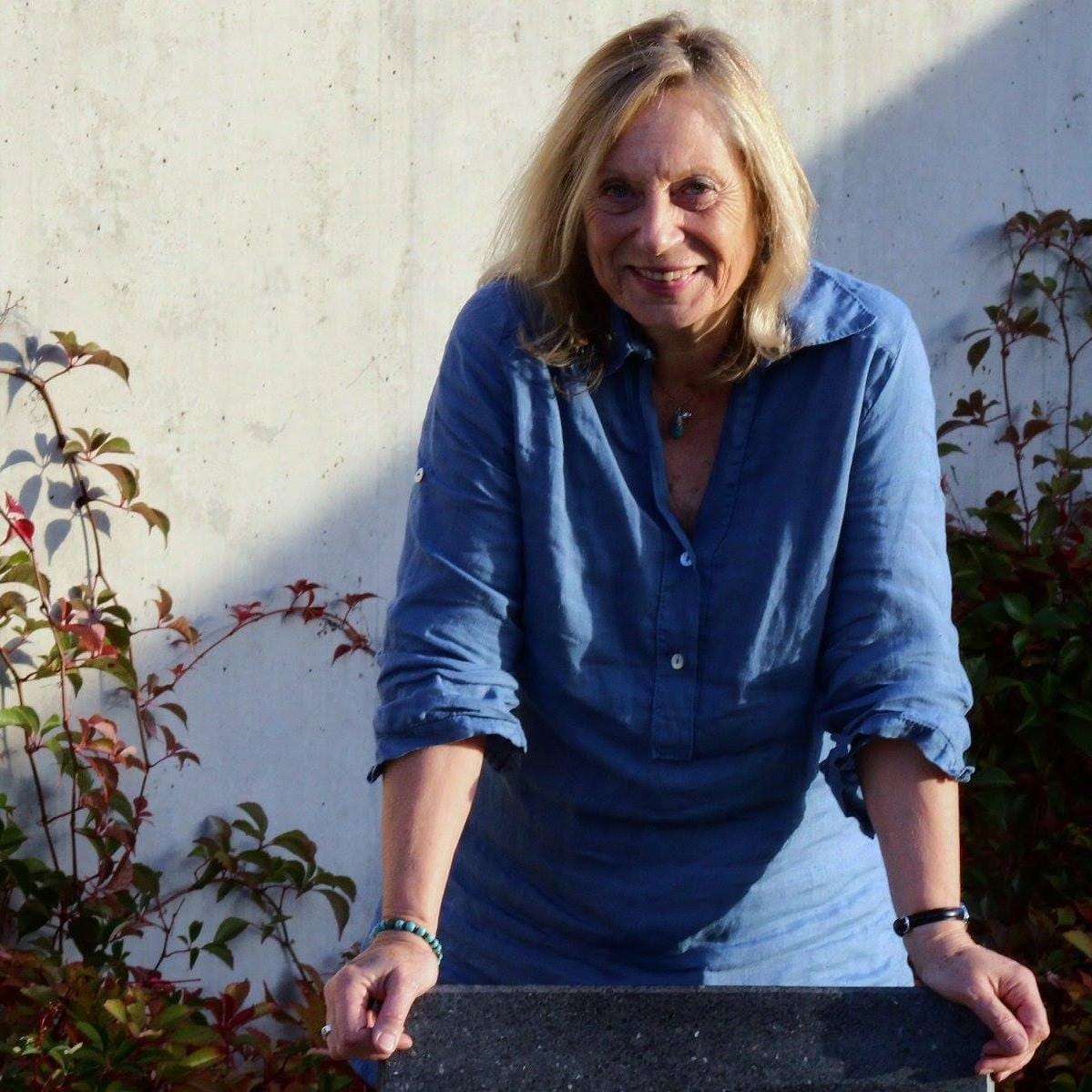
Jenny Lewis is a poet, playwright, translator and
songwriter
who teaches poetry at Oxford University.
She has had seven plays and poetry cycles performed with music and dance at
major UK theatres including the Royal Festival Hall and Pegasus Theatre, Oxford
for which she wrote Map of
Stars (2002), Garden
of the Senses (2005), After
Gilgamesh (2012) and, with Yasmin Sidhwa and Adnan
Al-Sayegh, Journeys to
Freedom: A Retelling of the 1001 Arabian Nights (2015).
Jenny’s first poetry book was When
I Became an Amazon (Iron Press, 1996/ Bilingua, Russia 2002)
which was dramatized, broadcast on BBC Woman’s Hour and the BBC World Service
and made into a prize-winning opera performed by the Tchaikovsky Opera and
Ballet Company (2017) and by the Orpheus Chamber Orchestra for International
Women’s Day 2023. Her later collections include Fathom (Oxford Poets/
Carcanet, 2007), Taking
Mesopotamia (Oxford Poets/ Carcanet, 2014), Gilgamesh Retold (Carcanet
Classics, 2018) which was a New
Statesman Book of the Year, an LRB Bookshop Book of the Week
and Carcanet’s first ever audiobook; and From
Base Materials (Carcanet, 2024). Jenny has also published three
chapbooks from Mulfran Press in English and Arabic with the exiled Iraqi poet
Adnan Al-Sayegh which are part of the award-winning, Arts Council-funded ‘
Writing Mesopotamia’ project aimed at building bridges between English and
Arabic-speaking communities. The project included collaborations with artists,
musicians and film-makers; seminars and readings at the Ashmolean Museum,
Oxford, the British Museum and the Iraqi Embassy; and a song, ‘Anthem for
Gilgamesh’ which has had over 100,000 hits on YouTube and Arab websites. Let me tell you what I saw,
Jenny’s translation (with others) of extracts from Adnan’s work, was published
by Seren in 2020. Jenny’s poems, reviews and articles have been published
by leading journals, including Anacapa
Review, Long Poem Magazine, Oxford Poetry, Oxford Magazine, Poetry Ireland
Review, Poetry London, PN Review, Poetry Salzburg, Poetry Wales, The Cork
Literary Review, The Daily Telegraph, The Financial Times, The Guardian, The
High Window, The Independent, The Poetry Review, The Rattle and World Literature Today. Her
most recent work is a sequence of ecopoems for Seed Guardians, written and directed by Yasmin
Sidhwa, for Mandala Theatre Company, first performed at The North Wall, Oxford
then touring to the Midlands, the North of England and London, October-November
2024. It won a Joseph Rowntree Award in 2025.
Jenny’s writing for children includes a
twenty-six-part children’s TV animation series, James the Cat, co-written,
with its creator, Kate Canning and first shown in 1998. Her song-writing
credits include ‘17 Pink Sugar Elephants’ with Vashti Bunyan (1964), later
developed with new lyrics by Alasdair Clayre into the iconic ‘Train Song’
which has been used on TV commercials (Reebok and Samsung) as well as for the
hit US shows True Detective
and Patriot and
been streamed over 20 million times.
In March 2021, Jenny completed a PhD on
translating Gilgamesh at Goldsmiths, University of London. You can read the
thesis here:
https://research.gold.ac.uk/id/eprint/30429/1/ENG_Thesis_LewisJ_2021.pdf
Travel Writing :
1. A Carcanet Poet Abroad – Jenny Lewis
in Morrocco Part 1
2. A Carcanet Poet Abroad- The next chapter-
Jenny Lewis in Morrocco Part 2
3. A Carcanet Poet Abroad: Homecoming
– Jenny Lewis in Morrocco Part 3
4. MSt
Tutor Jenny Lewis at the Al Kalima International Forum of Poetry, Morocco,
March 2015.